
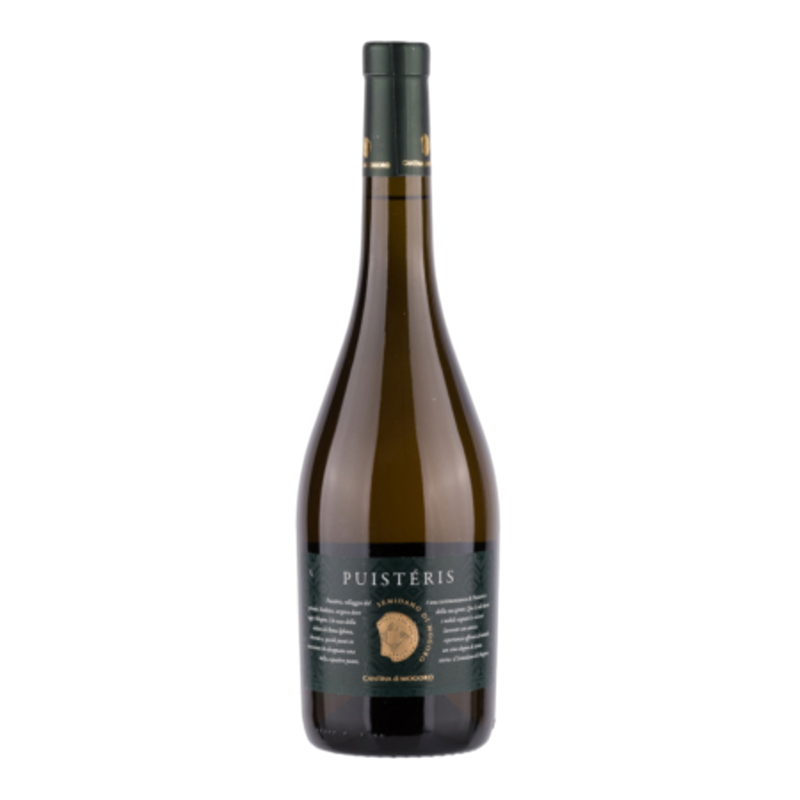

PUISTÉRIS


Sardegna Semidano di Mogoro DOC Superiore
CLASSIFICATION
Sardegna Semidano di Mogoro DOC Superiore
GRAPES
Semidano 100%
Puistéris is an ancient Neolithic vine that is located on a hill near the village of Mogoro.
SEMIDANO
It is a vine of which there are reports from 1780. After the unsuccessful attempts of production in other areas of the island, Semidano has been recognized as a grape of unique expression in
the area of Mogoro, obtaining the DOC with subzone Mogoro. It is an unproductive vine with small clusters, tight and medium resistance to cryptogams. Due to the vegetative aspect it is at
times confused with the Nuragus, seen the similar conformation of the prunings and the leaves. The ripening takes place from the second decade of September. In late harvest, from the first
decade of October, Semidano gives white wines of great structure and complexity or fascinating sweet wines.
TASTING NOTES
Bright and luminous golden yellow. Itis a wine thatstands outfor the balance of its characteristic olfactory taste. It has aromas that are revealed in progression, from broom, beeswax, honey,
helichrysum. In the mouth, the typicalsalinity and freshness accompany the persistence of fruity notes.
Alcohol: 13,50% vol.
Serving Temperature: 12-13° C.
IT’S BEST ENJOYED WITH…
It is an important wine that comesfrom late harvest, and has no residualsugar. Defined by some as an “intimate wine”, tasting is multifaceted, layered, elegant. Companion of first courses with
tasty fish sauce or white sauces based on shellfish. Baked scallops au gratin, shrimps and white sea soups; tasty fish with sauces in aromatic herb crust. White pizza with wild mushrooms, tasty
cheeses.
THE VINEYARDS OF PUISTERIS
Sapling vineyards aged between 30 and 40 years, on hilly land in the municipality of Mogoro and neighboring countries. The soil is on average calcareous, loose deep, consisting in part of
quaternary sands. The climate is Mediterranean with mild winters and hot summers, mitigated by the salty mistral wind. Average annual rainfall is 500 mm. The harvest takes place in the first
decade of October, with careful sorting of the most mature grapes and the mashing takes place within a few hours from the harvest. The harvesting operations are done late to allow a
greater accumulation of sugars and terpenes. The yield per hectare is 50/60 q.
VINIFICATION AND AGING
After a short maceration of the must on the skins and fermentation at low temperature, it ages for about 3 months in French oak barrels of 500 liters. It is made bâtonnage on the lees to
allow the wine to best express the qualities of body, structure and aromatic palette. Subsequent aging of 9 months in steel and 2 months in bottle.
BOTTLING AND DEVELOPMENT
Sterile under pressure of nitrogen. Long-lived wine, remarkable structure and extract; expresses better and ennobled its characteristics over time. Optimal storage conditions are fundamental
to appreciate the quality of wine..
Related Products

Vermentino di Gallura – Denominazione di Origine
Controllata e Garantita





Nuragus di Cagliari – Denominazione di Origine Controllata

The Nasco is a grape variety we can find in the southern part of the island and is highly appreciated for its quality, to the point of being considered one of the most important wines of Sardinia since the late 1800s, during the Vienna World Exposition. Its name is believed to come from the Latin term “nuscus,” which means moss, indicating a distinctive olfactory detail. It is a medium-vigor grape variety with semi-clustered and scattered bunches. The grapes typically ripen between the third decade of September and the first decade of October.



Reviews
There are no reviews yet.